Caution: the laugh factor (laughactor) of this post is virtually zero and it will most likely be interesting to no one but myself. This is instead an opportunity for me to have an English geek-out moment in a forum where I can't be interrupted. Consider yourselves warned. Also, it's long.
Tonight, being Thursday, Ylime and I had our traditional Thursday Therapy. Although admittedly we haven't honored the tradition in several years, it was apparent by our catalogue of homework we should be doing that some therapy was long overdo. In an effort to embark on a journey of artistic discovery, and also to entertain us for a couple of hours, we went to a BYU production of The Seagull by Anton Chekhov.
When I tell you that I have a deep partiality to Russian literature those readers who don't know me very well shouldn't feel left out. Most of the people who DO know me don't realize that either. But as Joni Mitchell is to Emma Thompson in Love Actually, so is Dostoevsky to my cold, English, heart. (or American. Whatever.)
First off, the play was amazing. Emily asked me what I liked about it so much and the only qualified response I can give is that hours later, I'm still stewing over it. Aside from the production being all-around awesome, there was one point the director brought up that still has me thinking.
After the final scene the director asked a question of the audience: is the play was a comedy or tragedy? After immediately rejecting the notion that it had to be labeled as one or the other I began thinking on what it would mean to be both a comedy and a tragedy, and whether the two are really so different after all.
Throughout the play there are moments of heart wrenching sadness, as well as giddy humor. (It has to be noted that a large portion of the humor depends on the enactment of the play, as one audience member recalled seeing an earlier showing completely devoid of laughs.) When I began to contrast these two virtues it occurred to me that each element was completely dependent on the other. In other words I decided that it was impossible to have a true tragedy without comedy and vise verse.
I'm not talking about tragedies like Oedipus Rex or Braveheart where you begin to wonder if the only aim of the film is to rip you heart out and leave it still beating on the living room carpet. What I'm talking about is something much more subtle. When the humor and normality of the events allow the audience to become a part of story (something drastically enhanced by this production in an arena theater) there's a lightheartedness that persuades you that nothing terrible is going to happen. So when you see a main character show up haggard and only half coherent you do not mourn because it's as if her misfortunes have happened to you. You mourn because you remember the funny way that she used to bounce around and the light in her eyes when she mused about art and theater. The pain is much more acute. It's directly related to an experience we may never have, but the dramatic effect it has on the characters is something we come to understand very well.
The Seagull will break your heart. But the impact will be much more lasting when it's contrasted with the small comedic moments of pure delight.
P.S. If I know you, and you're on the production crew, and I didn't loudly say your name and wave hello during intermission don't feel bad. I'm just awkward like that.
Showing posts with label subtle review. Show all posts
Showing posts with label subtle review. Show all posts
Thursday, November 08, 2007


Wednesday, July 25, 2007
Book Club: New Moon
Two days later, and another book done. This time I decided to stretch the fun out for an extra day, and somehow managed to get to bed before the sun peaked out from behind the mountains. While it seems unlikely, the second book in the Twilight trilogy is possibly better than the first. What could possibly be better than an impromptu relationship with an Adonis like vampire? Unrequited love, cliff diving, and werewolves. That's what. (No spoilers intended; any keen reader should pick these up from clues in the first novel, as well as the title of the second.)
Whatever action elements were missing from Twilight Meyer more than makes up for in the second installment, New Moon. This time the focus is shifted from the perfection of Edward, and Bella's insecurities, and instead follows Bella's attempts to avoid a complete mental breakdown after her life takes some unexpected twists. We get to know Bella's family friend Jacob Black much better, and although he can't compare with Edward's down right perfection, his earthy, boyish nature will make many of the female readers waver in their loyalty.
With Bella's world turned around the dour mood of the second novel puts real perspective on her situation and it is here that the genius of writing in the first person shines through. Changing the rules with any established myth can be an dangerous and potentially cliche thing to attempt, but seeing this new world through Bella's eyes allows us to accept her occasional skepticism and surprise without question. It is much easier to believe what Bella thinks, rather than what we would think, and thus we gladly surrender ourselves.
Although the end comes abruptly (there is a preview chapter of book three at the end, giving false hope of another twenty pages) the best part of New Moon is the scenario set up for future novels. With Eclipse coming out August 7th and the fourth slated for September 2008 I'm excited to have another YA series to look forward to.
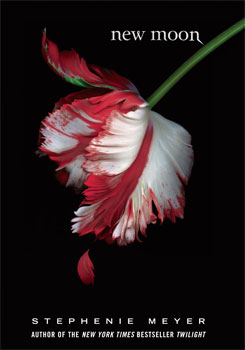
Good if you're looking for: something to distract you from the fact that there will be no more Harry Potter books
Effort to Enjoy: 2 (out of 5)
Tuesday, July 24, 2007
Book Club: Twilight
After an accidental reading-enthusiast explosion of book recommendations on an unsuspecting friend I've decided to spare the innocent bystanders and you to my reading whims instead. Welcome to the Subtle Book Club!
I know what you're expecting to review. But no, I'm not going to. I figure you're still going to read Harry Potter 7 even if I tell you that in the end Harry di. . . just kidding. I'm not that cruel. Instead I'm going to tell you about my AFTER HP book.
It's Twilight by Stephenie Meyer and I've been hearing about it for MONTHS. First we talked about it ENDLESSLY in my SciFi writing class (I know.) THEN Stephenie was on numerous panels at the fantasy convention (I said I KNOW) and on top of all that no less than 5 people have recommended it to me, one of them even enticing me with the fact that in her acknowledgments she thanks one of my favorite bands.
I finally got around to starting the book last night . . . and then I finished it last night. The story is about a 16 year old girl who moves Washington to live with her Dad, and starts spending time with a strange classmate. Ok. I'll let the cat out of the bag. He's a vampire. (The inside flap of the book confirms it.) But ladies don't let that put you off! In fact, this is probably better classified as a Urban-Fantasy-Romance. Yes, it has vampires. No, it won't keep you up at night chewing on garlic bread.
While the plot itself might be a bit simplistic Meyers does an excellent job making sure that you are interested in what really matters: the relationship between Bella and Edward. Although mildly concerned about the whole vampire issue, the complexities that it brings to their relationship is what is really intriguing. I've heard from several guys that they find the main male character extremely shallow, but that doesn't seem to stop all the girls from swooning and giggling as they read
Long story short, if you like Harry Potter, Dracula, and any books with characters named LaMaster Scott Gange then you'll love this book.
 Twilight by Stephanie Meyer
Genre: Urban Fantasy (YA)
Good if you're looking for: something light that will grip, and entertain, and make you wish you had gorgeous vampires at YOUR school.
Effort to Enjoy: 2 (out of 5)
I know what you're expecting to review. But no, I'm not going to. I figure you're still going to read Harry Potter 7 even if I tell you that in the end Harry di. . . just kidding. I'm not that cruel. Instead I'm going to tell you about my AFTER HP book.
It's Twilight by Stephenie Meyer and I've been hearing about it for MONTHS. First we talked about it ENDLESSLY in my SciFi writing class (I know.) THEN Stephenie was on numerous panels at the fantasy convention (I said I KNOW) and on top of all that no less than 5 people have recommended it to me, one of them even enticing me with the fact that in her acknowledgments she thanks one of my favorite bands.
I finally got around to starting the book last night . . . and then I finished it last night. The story is about a 16 year old girl who moves Washington to live with her Dad, and starts spending time with a strange classmate. Ok. I'll let the cat out of the bag. He's a vampire. (The inside flap of the book confirms it.) But ladies don't let that put you off! In fact, this is probably better classified as a Urban-Fantasy-Romance. Yes, it has vampires. No, it won't keep you up at night chewing on garlic bread.
While the plot itself might be a bit simplistic Meyers does an excellent job making sure that you are interested in what really matters: the relationship between Bella and Edward. Although mildly concerned about the whole vampire issue, the complexities that it brings to their relationship is what is really intriguing. I've heard from several guys that they find the main male character extremely shallow, but that doesn't seem to stop all the girls from swooning and giggling as they read
Long story short, if you like Harry Potter, Dracula, and any books with characters named LaMaster Scott Gange then you'll love this book.

 Twilight by Stephanie Meyer
Genre: Urban Fantasy (YA)
Good if you're looking for: something light that will grip, and entertain, and make you wish you had gorgeous vampires at YOUR school.
Effort to Enjoy: 2 (out of 5)
Subscribe to:
Posts (Atom)